Published September 2026 · 7 min read
Most people know daylight saving as a twice-a-year annoyance: one hour, one Sunday, one groggy Monday. If your team sits in a single country, that's exactly what it is.
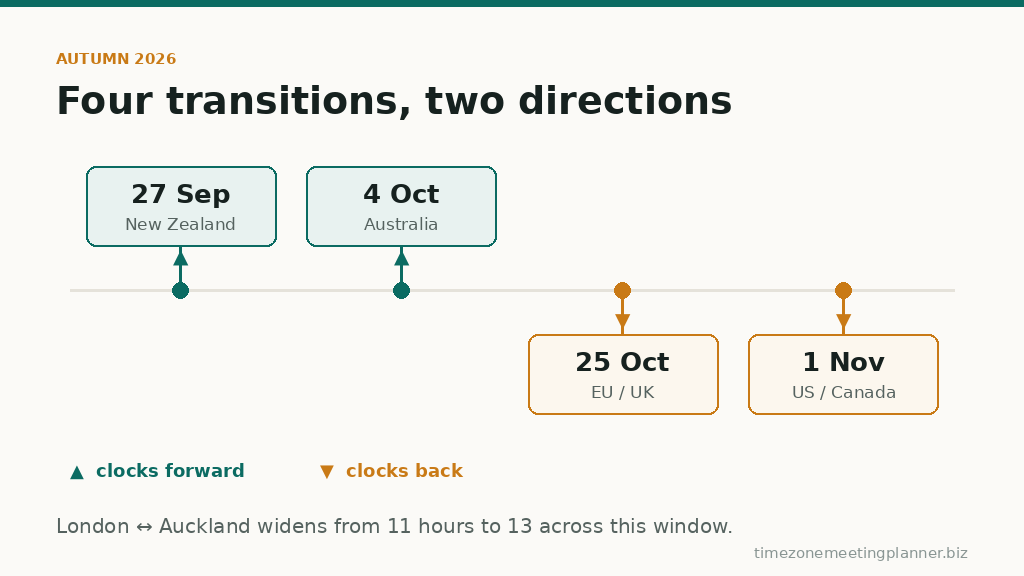
If your team spans hemispheres, the next six weeks are something else entirely. Between 27 September and 1 November 2026, four separate daylight saving transitions land — and they don't all move the same way. New Zealand and Australia spring forward while Europe and North America fall back. For a London–Auckland meeting, the gap widens from 11 hours to 13 over the course of a month, in two separate one-hour jolts, on dates nobody has in their calendar.
Here's the full cascade, which city pairs it moves, and what to do before it starts.
The four dates
In chronological order, with the direction each one moves:
- Sunday 27 September — New Zealand starts DST. Auckland goes UTC+12 → UTC+13.
- Sunday 4 October — Australia starts DST. Sydney, Melbourne, Canberra, Hobart and Adelaide move forward one hour. Brisbane, Perth and Darwin do not — Queensland, Western Australia and the Northern Territory don't observe it at all.
- Sunday 25 October — The EU and UK end DST. London goes UTC+1 → UTC+0; Berlin, Paris and Madrid go UTC+2 → UTC+1.
- Sunday 1 November — The US and Canada end DST. New York goes UTC−4 → UTC−5; Los Angeles goes UTC−7 → UTC−8.
Two of those move clocks forward. Two move them back. That's the part that catches teams out — a mental model built on "everyone changes at roughly the same time, in roughly the same direction" is wrong for six weeks a year.
What actually moves, pair by pair
An offset change only matters if it changes the gap between two cities. Here's how the common pairs shift across the window:
London ↔ Auckland: 11h → 12h (27 Sep) → 13h (25 Oct)
London ↔ Sydney: 9h → 10h (4 Oct) → 11h (25 Oct)
New York ↔ Sydney: 14h → 15h (4 Oct) → 16h (1 Nov)
New York ↔ London: 5h → 4h (25 Oct) → 5h (1 Nov)
London ↔ Mumbai: 4.5h → 5.5h (25 Oct)
New York ↔ Tokyo: 13h → 14h (1 Nov)
London–Sydney is the one worth staring at. Over 21 days it moves twice, in the same direction, for two completely unrelated reasons: Australia springs forward on 4 October, then Britain falls back on 25 October. A standing call that worked comfortably in September is two hours off by November — and neither side did anything wrong.
The one-week window
Between 25 October and 1 November, Europe has changed and North America hasn't. For that single week, New York sits four hours behind London instead of the usual five.
This is the autumn version of a gap that regular readers will recognise from spring — but it behaves differently. In March, the US springs forward on the 8th and Europe waits until the 29th, giving a three-week window. In autumn the order flips and the window narrows to one week. Same phenomenon, a third of the duration, which is precisely why it slips past people who learned to watch for it in March.
For that week, a 9:00 AM New York call lands at 1:00 PM in London rather than 2:00 PM. That's usually harmless. Where it bites is the edges: a 4:00 PM New York meeting that normally catches London at 9:00 PM now arrives at 8:00 PM, and an 8:00 AM London call that was a comfortable 3:00 AM problem for New York becomes a 4:00 AM one. If you have a meeting that only just works, check it against that week specifically.
The places that don't move at all
Roughly a third of the world observes daylight saving. The rest hold steady, which means their gap to you changes even though nothing changed for them:
- India, China, Japan, Singapore, Hong Kong, South Korea — no DST anywhere in the region.
- Most of Africa, including South Africa, Nigeria, Kenya and Egypt's year-round zones.
- Brazil, which abolished DST in 2019 — a change that still trips up teams working from older reference tables.
- Mexico, which abolished it nationally in 2022, retaining it only in some northern border municipalities that align with the US.
- Queensland, Western Australia and the Northern Territory — so on 4 October, Sydney and Brisbane stop sharing a clock and don't share one again until April.
That last one deserves emphasis if you work with Australian colleagues. For six months of the year, "Australian Eastern Time" refers to two different offsets depending on which side of the Queensland border someone sits.
Five things to do before 27 September
- Audit your recurring meetings for cross-hemisphere pairs. Anything joining Australia or New Zealand to Europe or North America will move twice in six weeks. Everything else moves once or not at all. That's usually a short list — start there.
- Confirm each recurring event has a named time zone, not a fixed UTC offset. An event stored as "UTC+1" won't follow London through 25 October; an event stored as "Europe/London" will. This is the single most common cause of meetings quietly drifting.
- Pick a lead time zone per meeting and say so out loud. Decide whose local time stays fixed — then everyone else's shifts around it predictably, and there's no ambiguity about who's expected to absorb the change.
- Re-check meetings that sit near someone's boundary. A 7:00 AM or 7:00 PM call has no slack. An hour in the wrong direction turns it into a 6:00 AM or 8:00 PM call, and those are the ones people quietly stop attending.
- Diarise the four dates now. Not as reminders to change anything — as reminders to look. Most DST damage isn't the shift itself; it's discovering it three weeks later from someone who's been joining at the wrong hour without saying anything.
Why this keeps happening
Calendar software handles DST correctly. It has for years. The failures aren't arithmetic — they're assumptions.
Someone converts a meeting time once, writes it into a document or a Slack channel topic, and it becomes the reference everyone trusts. The calendar entry updates itself on 25 October. The pinned message doesn't. Six weeks later, half the team is working from a number that stopped being true.
The fix isn't better mental arithmetic. It's not writing converted times down as though they're permanent, and re-checking the ones you inherited whenever the offsets move — which, for the next six weeks, is four separate times.
Want to see exactly how a specific meeting moves across these four dates? Add your cities to the planner and change the date to a week after each transition — the overlap chart recalculates with the correct offsets. Try the Time Zone Meeting Planner →