Published September 2026 · 7 min read
US–Europe is the most common transatlantic pairing in remote work, and it has a reputation for being easy. Compared to US–India, it is.
But "easy" hides a large gap between coasts. A New York–London team has a genuinely comfortable three-to-four-hour overlap. A San Francisco–Berlin team has about two hours, both of them awkward. Teams often plan as though those two situations are the same problem, then wonder why the West Coast engineers never speak up.
Here's where the overlap really sits for each combination, and how to use it.
The offsets you're working with
Through most of the year, the standing gaps are:
- New York ↔ London: 5 hours
- New York ↔ Berlin / Paris / Madrid: 6 hours
- Los Angeles ↔ London: 8 hours
- Los Angeles ↔ Berlin / Paris / Madrid: 9 hours
- Chicago ↔ London: 6 hours
- Denver ↔ Berlin: 8 hours
Those hold for most of the calendar, but not all of it — the two DST windows are covered further down.
East Coast ↔ UK and Europe: the comfortable case
With a five-hour gap to London, a standard 9-to-5 in New York overlaps 9:00 AM–12:00 PM Eastern with 2:00–5:00 PM London. That's three hours where both sides are unambiguously at work, nobody is eating lunch, and nobody is watching the clock to leave.
Golden window, US East ↔ UK: 8:00–11:00 AM ET = 1:00–4:00 PM London
Golden window, US East ↔ Central Europe: 8:00–10:30 AM ET = 2:00–4:30 PM Berlin
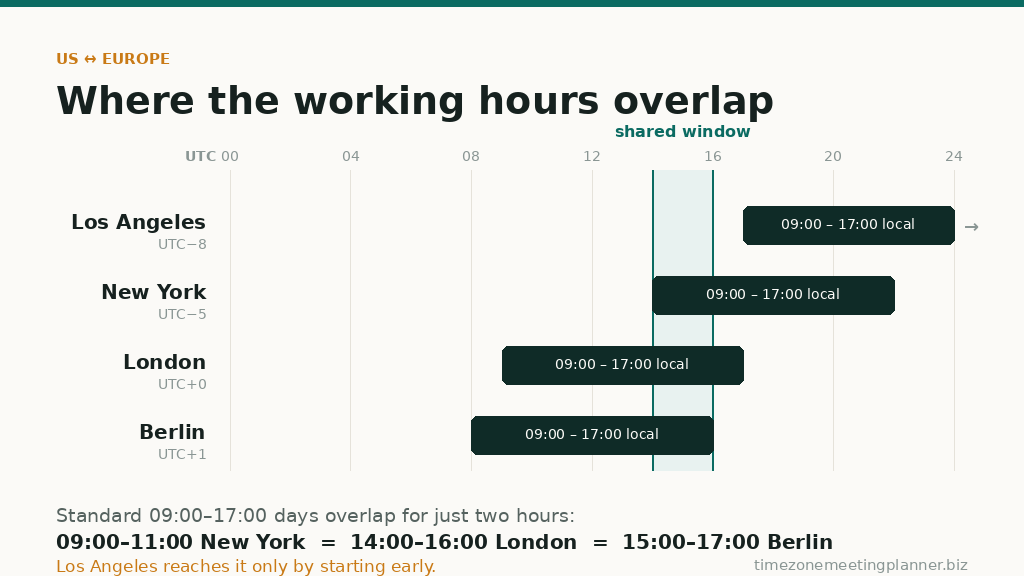
The 8:00 AM ET start is deliberate, and it's slightly wider than the strict overlap. If everyone works a rigid 9:00–17:00, New York and Berlin genuinely share only two hours — 9:00–11:00 AM ET, which is 15:00–17:00 in Berlin. Starting at 8:00 ET buys a third hour and moves the European end away from their 5:00 PM cliff. Pushing later does the opposite: 4:30 PM is the practical ceiling in Berlin, Paris and Madrid, after which you're competing with school runs and the end of the working day.
One caution: the Central European lunch break is real and it's later than the American one. A 12:30 PM Berlin call — 6:30 AM in New York — is bad for both sides for entirely different reasons. Avoid 12:00–2:00 PM CET.
West Coast ↔ Europe: the two-hour problem
Nine hours between Los Angeles and Berlin means a standard workday overlap of roughly zero. If Berlin works 9:00 to 17:00 and Los Angeles works 9:00 to 17:00, they never share a minute — 9:00 AM in LA is 6:00 PM in Berlin.
The overlap only exists if someone stretches:
US West ↔ UK: 8:00–10:00 AM PT = 4:00–6:00 PM London
US West ↔ Central Europe: 7:30–9:00 AM PT = 4:30–6:00 PM Berlin
That's two hours at best, and it's asymmetric: it costs the US side an early start and the European side their evening. Neither slot is neutral, and the cost lands on the same two people every single week if you let it.
Three ways teams handle this in practice. Alternate the pain — run the call at 8:00 AM PT one week and 8:00 AM CET the next, so both sides take turns being inconvenienced. Shrink the sync — a 25-minute decision-focused call is a much easier ask at 5:30 PM Berlin than a 60-minute status meeting. Or don't meet — if a West Coast–Europe pairing is core to your team's work, the answer is usually an async-first workflow rather than a cleverer calendar slot. There's a longer argument for that in async vs. sync communication.
The whole-team meeting
If your team spans Los Angeles, New York and Berlin simultaneously, there is exactly one viable window:
8:00–9:00 AM Pacific = 11:00 AM–12:00 PM Eastern = 5:00–6:00 PM Central European
One hour. That's it. Everything earlier is unreasonable in California; everything later is someone's evening in Germany. If you need a recurring all-hands across those three, that hour is the answer, and it's worth protecting rather than rediscovering every quarter.
What DST does to all of this
The US and EU change clocks on different dates, which creates two windows a year where every number above is wrong by an hour.
In spring 2026, the US sprang forward on 8 March and the EU waited until 29 March. For those three weeks, the New York–London gap was 4 hours instead of 5. In autumn 2026, the EU falls back on 25 October and the US on 1 November — a one-week window where the gap is again 4 hours.
A narrower gap sounds like good news, and for the East Coast it mostly is. For the West Coast it genuinely helps: during those windows the LA–Berlin gap drops to 8 hours, which turns the two-hour overlap into a slightly less brutal one. The problem is that it reverses without warning, and a meeting booked at the edge of the window stops working the moment the offsets snap back.
The reliable approach is to store recurring meetings against a named time zone — America/New_York, not UTC−5 — and to nominate one city as the anchor whose local time stays fixed. Then the shift happens in a predictable direction for everyone else instead of scattering. The autumn 2026 transition schedule has the exact dates.
Four rules that hold up
- Book against the tighter constraint. In a US–Europe meeting, Europe's end-of-day is almost always the binding limit. Start from "what's the latest acceptable time in Berlin" and work backwards.
- Treat 8:00–11:00 AM Eastern as protected time. It's the only reliably shared window across the whole pairing. Filling it with internal US-only meetings is how transatlantic teams end up unable to find a slot.
- Rotate anything that costs someone their evening. A meeting that's permanently 5:30 PM for the same person is a retention problem dressed up as a scheduling one.
- Write the time zone into the invite title. "Weekly sync — 9:00 ET" removes an entire category of confusion, and it survives being copied into a document, which the calendar entry doesn't.
Add your team's actual cities — not just the examples here — and see the real overlap on one 24-hour scale, with DST transitions flagged. Try the Time Zone Meeting Planner →